Day 48: Siem Reap. Final thoughts.

Five days ago…

While standing in the blazing heat, sweat soaking my back under a knapsack that seems to get heavier with every minute, I decide Angkor Wat is a disappointment. It is huge, true. It has some beautiful carvings, certainly. But it isn’t beautiful. It doesn’t move my soul the same way Machu Picchu did. The tour guide keeps yammering on about kings and carvings while crowds push past. Every view of the temple is ruined by distracting bright yellow and pink t-shirts from various tour groups. I am sad. A dream held for over a decade, and this is it. A rainbow of movement clambering for the best shot, a buzz of hundreds of voices and accents yelling excidely. I shift under the weight of my bag and sigh from boredom and impatience.

Angkor Wat. A huge, sandstone complex surrounded by a 620 foot wide moat. The moat serving an unusual purpose – keeping the clay foundation from drying out and collapsing the temple complex that sits on it. The temple contains 5 ornate towers shaped like lotus buds and its three levels rise majestically above the otherwise flat landscape. There is no doubt the engineering of Angkor Wat is an amazing feat. But from down here on the ground where it’s size and ornate towers are obscured it looks like a cement wall, nothing like the perfect aerial shots you picture when you think of Angkor Wat.

Today...

Our last day in Siem Reap and we are feeling well enough to get out and explore. One thing I really wanted to check out was the silk factory. As a child I was skeptical that silk was stronger than steel and amazed that this delicate and fine thread came from “yucky” worms. As an adult, this fascination has not diminished. The opportunity to see for myself the process of making silk from tree to worm to fabric was not something I could miss. We hired Mr. Mean, a beaming, friendly man who beguiled his name as our personal tuk-tuk driver for the day. (He later proved to be an aggressive and “mean” driver, something we appreciated when trying to fit in one last temple before sunset and temple closing time).

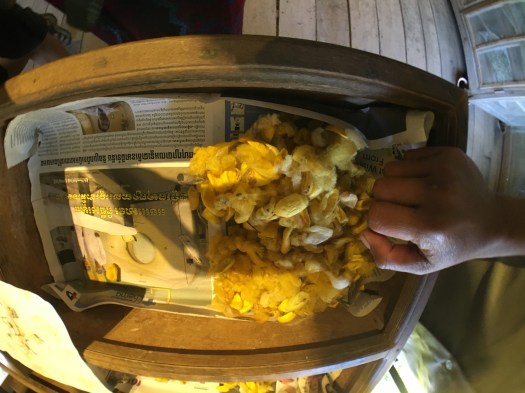
First stop, silk farm. Here we see a large field growing various species of Mulberry trees. Some species were even from Canada as research is conducted on the best type of Mulberry tree for making silk. We see silk worms happily munching away on Mulberry leaves. We see cotton balls of yellow that are in fact the cocoons that will be boiled, spun and dyed to create silk thread. And finally, the painstaking process of hand tying silk treads with plastic to create “tie-dyed” thread, and the mind boggling art of looming. My awe and fascination with silk only enhanced after watching skilled artisans perform the process of creating it.

Silk worms munching on Mulberry leaves. Amazing skill and patience to hand loom. Little cocoons of wonderment!

After the silk factory it was time for lunch before heading back to the temples. Mr. Mean selected a restaurant for us. We enjoyed fresh coconut water and local curry with the company of our scooter tour guide from the previous day. He just happened to be at the same restaurant while waiting on his “new” client.

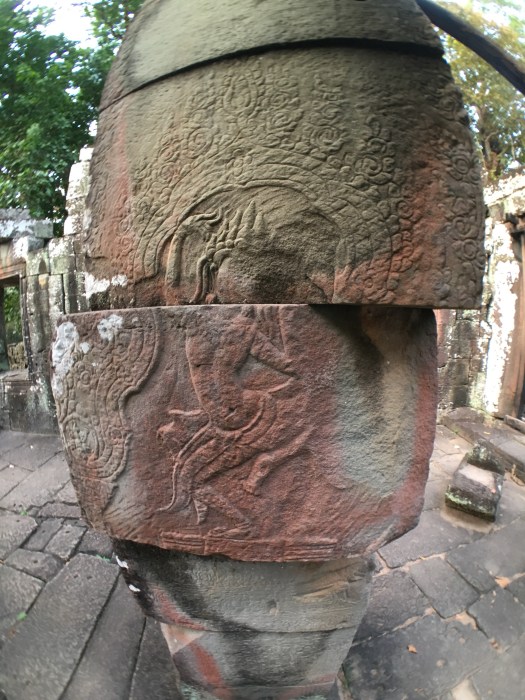
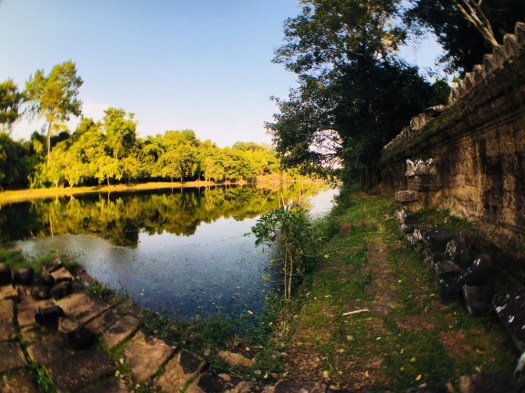
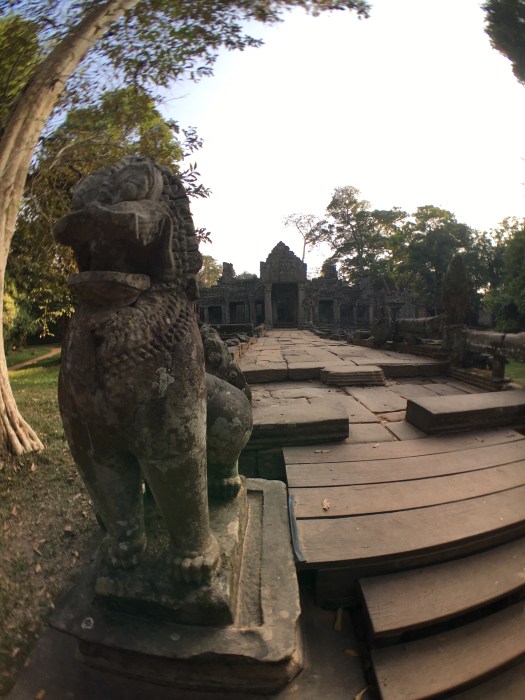
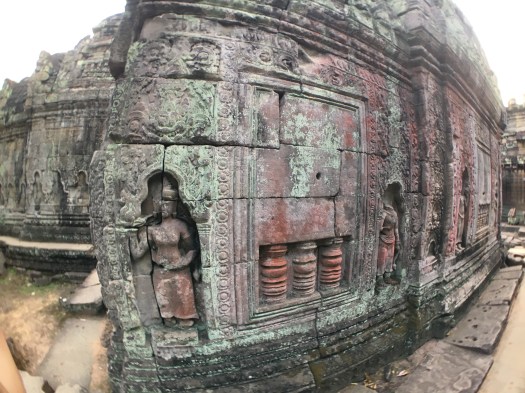
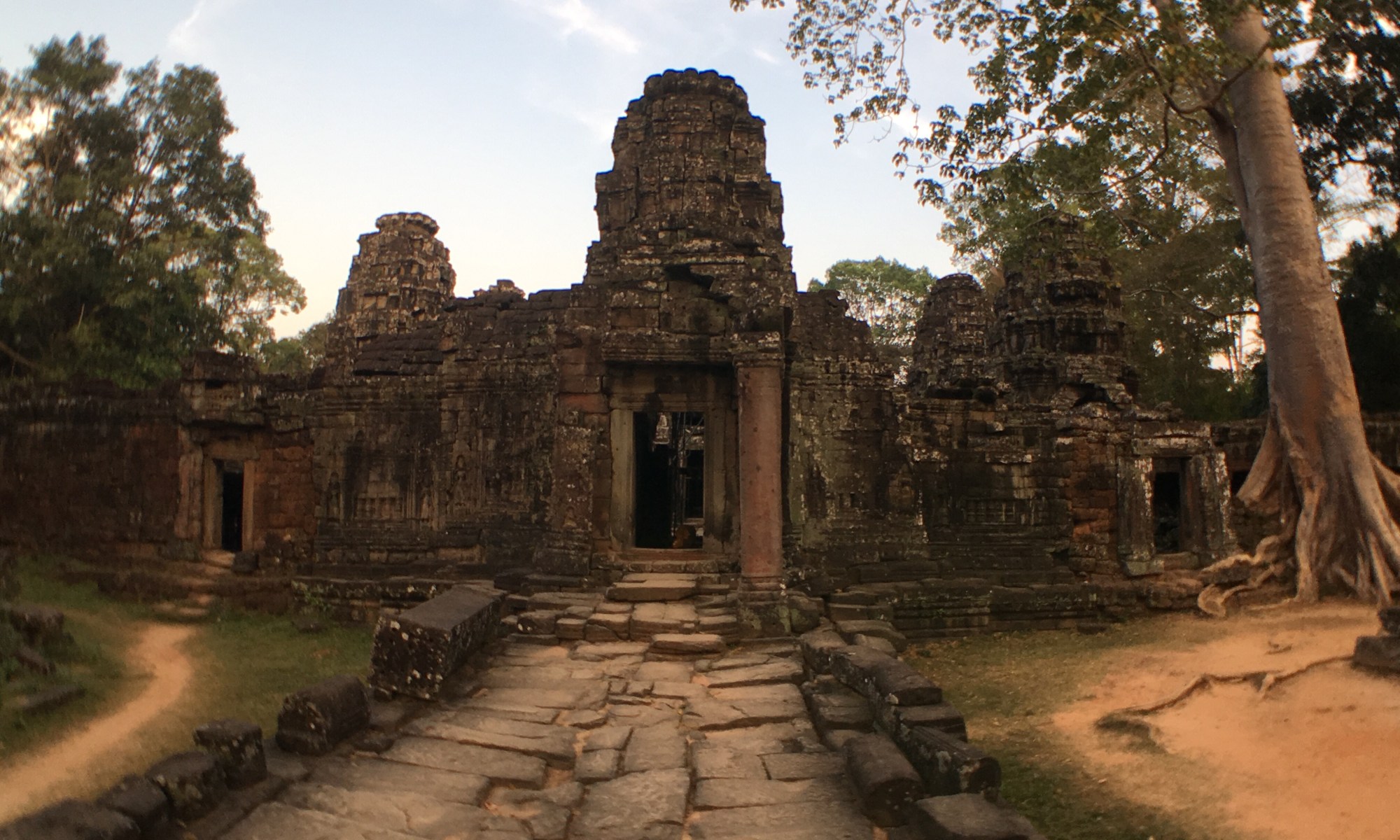
After lunch was the temple Preah Khan, built in the 12th century to honour the kings father. Perhaps it was the lack of crowds, (there were no more than a dozen people), the “cold” day (a wonderful 18 degrees) or not knowing what to expect from this temple. Whatever the reason, this quickly became our favourite temple bumping Banteay Srei, Ta Prohm and Bayon down the list. This temple had it all. A large temple with beautiful earthy reds, greys and greens, surrounded by a picturesque moat. Massive trees over growing temple walls. Beautiful carvings of apsara dancers. It had everything the other four famous temples had together. We explored this temples many rooms, surrounding ponds, jungle and elaborate carvings in peace. The only company we had were birds singing and mosquitoes buzzing. I finally felt the magic. Not just the magic of this one temple, but I came to appreciate the incredible magnitude of the temples taken together.

The sun was quickly dipping behind the massive trees and dusk was inevitable. We wanted to see one last temple, one on the opposite side of Angkor city from where we were. Mr. Mean was confident he could get us there before closing time and we raced off in the tuk-tuk, beaming with joy as we sped past even more temples (Ta Keo) and other tuk-tuks whose passengers looked at us with incredulity and fear as we played chicken with oncoming vehicles. Mr. Mean was a fellow driver.

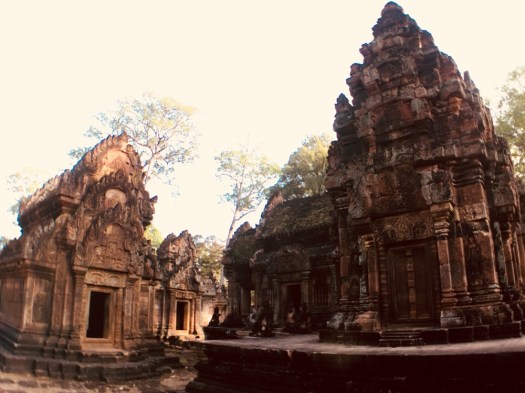
We made it to Banteay Kdei as the sun was setting. The only two people there. No doubt everyone else was fighting for a view from one of the many sunset temple viewpoints. Not as beautiful as Preah Khan or Benteay Srei, or as magical as Ta Prohm, it was still magnificent.

I was told we would get sick of seeing temples. That they would all look the same after awhile. As the sun was setting over this, our last temple, I was thankful I wasn’t at this point yet. I was able to appreciate the unique beauty of this final temple and leave Siem Reap with a deep sense of gratitude that we were able to visit this truly incredible place.

To complete our visit to Cambodia we headed downtown for a final walk around Old Market. We hadn’t yet had a fish massage and this was the last item on my Siem Reap bucket list. Once we were there, standing in front of the aquarium full of fish that suddenly seemed much bigger than I remembered, I wasn’t so sure. I have a fear of water for a reason. I don’t like the “things” that inhabit it. Even a dolphin will scare me senseless when it suddenly surfaces next to me while windsurfing or SUP’ing.

Shawn reminded me that this was on my bucket list and that I had to do it. Of course he was right. I pulled off my shoes and took the proverbial and literal plunge. It wasn’t at all what I was expecting. It was worse. I thought the sensation would be that of a light poking. It was more like hundreds of small electric pulses. It tickled and occasionally stung. It was an awful yet addictive sensation. After 10-15 minutes I was done. Shawn lasted a few minutes. We were good for business, convincing numerous other tourists to give it a shot, including a friendly young Brazilian woman. We stayed to support her as she gave it a skeptical try.

Where do they get the fish? From the river running through Siem Reap. Where do the fish go when they get too big? Back to the river for fishermen to catch and BBQ on street side stalls. Feeding the tourists the same fish that just fed off their feet. You had to love the resourcefulness.

When we got back to our hotel later that night I was shocked. My feet were perfectly smooth. The fish massage was better than any pedicure I had ever gotten. I laughed. What I thought was just another tourist trap actually worked.

Final thoughts

Having now seen numerous temples in the Siam Reap area, I am a believer. This place is special. The temples taken together are a spectacular display of engineering, architecture and intricate beauty. The surrounding jungle that has overgrown many of the temples is an added seduction that only enhances the magic and mystery of the temples.

This is a bucket list item that will not disappoint.

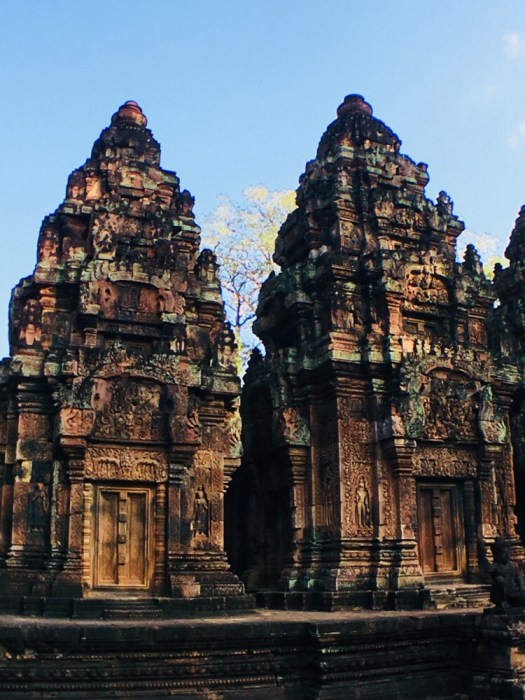
Apsara dancers. There are thousands of these beautiful carvings in every temple. Incredible! I love the earthy colours! Preah Khan moat. Preah Kahn entrance. Preah Kahn Preah Kahn

Banteay Kdei

Day 47: Kulen Mountain, Cambodia by Scooter

The day started roughly once again. Still sick from travellers diarrhea and suffering from an extreme lack of sleep, it was a rude awakening call when the alarm clock went off at 6:30 am. But we had a scooter trip booked for today, and there was no way we were going to miss out on an opportunity to see the Cambodian countryside.

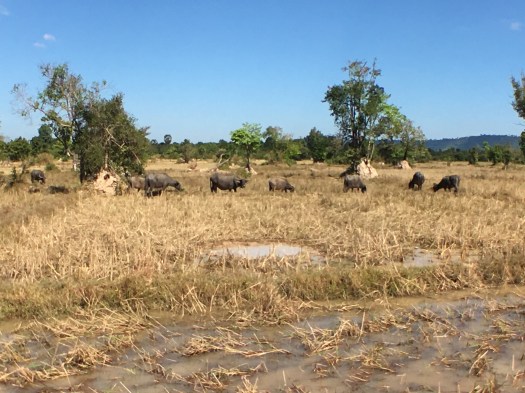
We headed off to Phnom Kulen on our 125 cc scooters. The ride took us through the countryside on rarely used dirt roads. It was an incredible contrast to Northern Vietnam in every way possible.

Hot with a beautiful blue sky.

Peaceful, not a single toot of a horn.

No livestock running widely about.

A landscape utterly flat.

Men, not women, performing hard labour.

Children watching us, never waving to us.

The steep, terraced rice fields and thick forests of Vietnam replaced by bright green, flat rice paddies dotted with tropical palm trees. Small villages replaced with spread out farms.

It reminded us of a tropical Saskatchewan, if there could be such a thing.

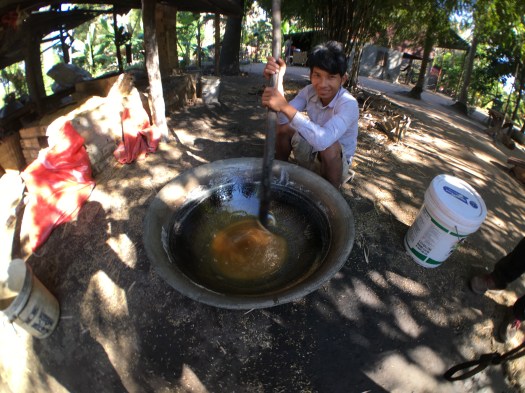
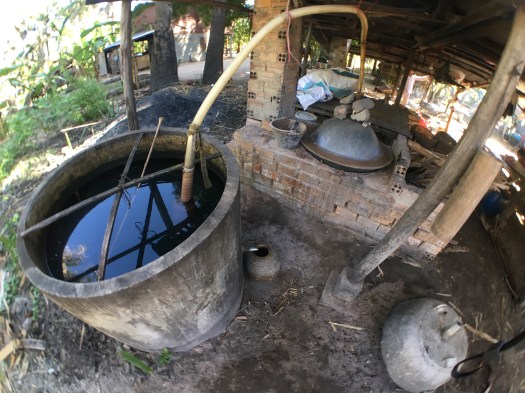
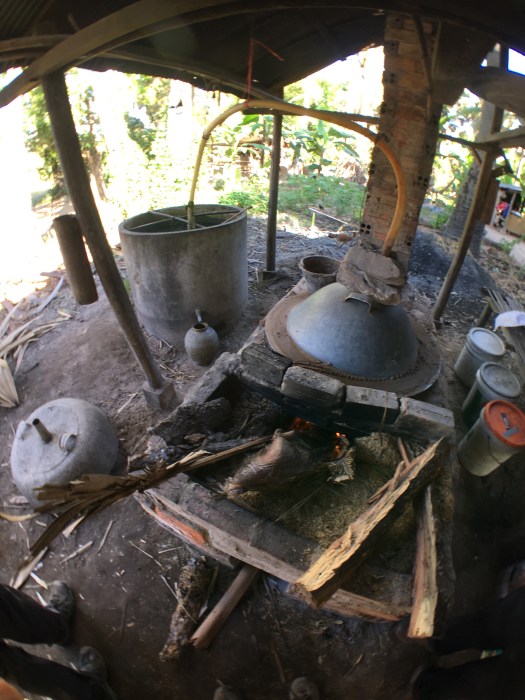
We admired the beauty and were in awe of the lifestyle of the farmers who make up 70% of Cambodia’s population. A man with one leg, sadly a common site in a country who only recently recovered from civil war, awkwardly fishing by hand. Men and women working the rice paddies and weaving baskets from dried weeds. We stopped at a local farm where we watched palm sugar been made. Rice husks were burned to heat palm juice until a thick, brown syrup was formed. The syrup was then stirred by hand until the water evaporated and small crystals were left. The same farm was making rice wine. Fermenting rice in buckets and then distilling the liquid over a fire fuelled by dried palm leaves. The remaining rice used as hog feed. Every part of every natural resource having a distinct purpose as either food, fuel, building material or feed. Making palm sugar. After riding through the countryside we arrived at the mountain range of Phnom Kulen. A 40 km long range, 400 meters high. Also the source of the sandstone used to build many of he Angkor Temples. We climbed up a series of switchbacks through forest and massive boulders.
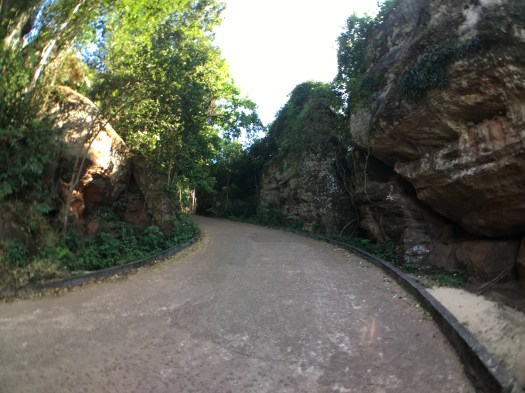
Road to Kulen Mountain.

We enjoyed lunch at the Kulen Mountain waterfall before heading to Wat Preah Ang Thom, home of the reclining Buddha. The reclining Buddha is a huge Buddha carved into the top of a sandstone boulder on the summit of the mountain. I loved this Wat. Where the temples of Angkor seem ancient and forgotten, Wat Preah Ang Thom is colourful and lively as a modern day temple. The Buddha itself being only 500 years old.

Next was the “Thousand Lingas”. This was also very cool as I had no idea what to expect, having never heard of this attraction. The Thousand Lingas is the name given to the riverbed above the waterfall. 1,000 Lingas and Yoni have been carved into the riverbed, their purpose to turn the river water into holy water for the king to bathe in below. Peering into the clear water of the river unclear of the “attraction”, I was shocked to see perfect, repeating patterns dancing beneath the water. Another marvel from the 11th century.

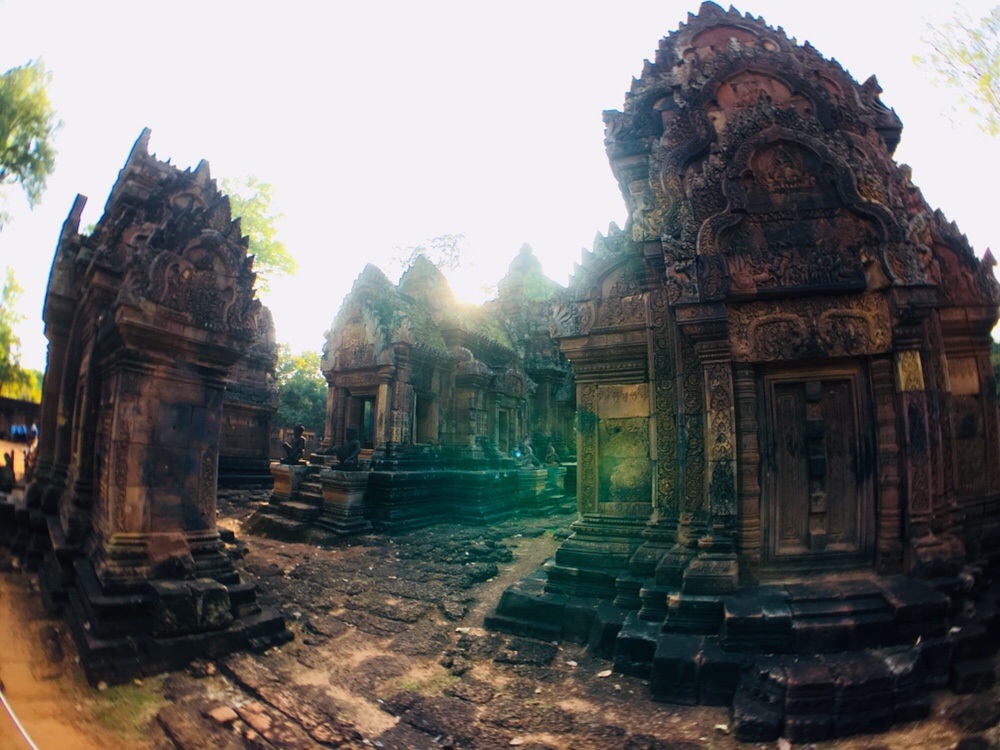
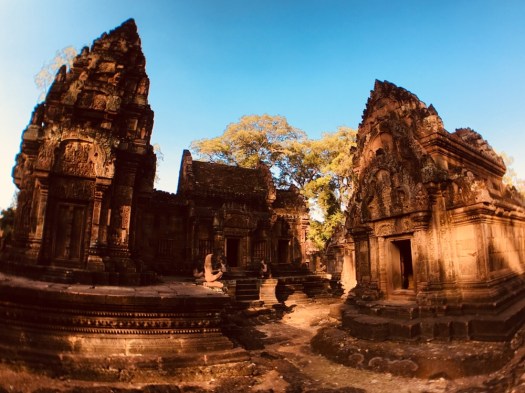
Our final stop was the temple Banteay Srei. An 11th century temple dedicated to the Hindu god Shiva. Another impressive temple with intricate carvings, earthy natural colours and great beauty. I thought I would get sick of seeing temples, but the beauty and unique characteristics of every temple has surprised and impressed me. I loved Banteay Srei as much as the other temples.

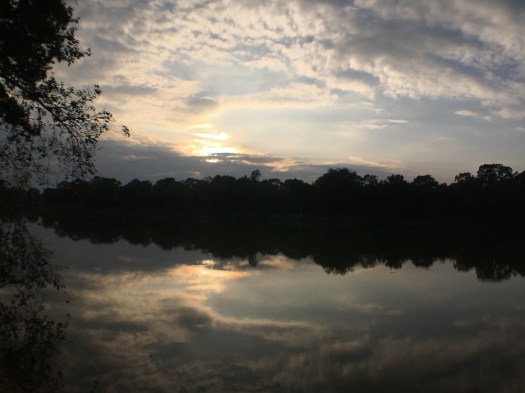
We drove back to Siem Reap as the sun set over the moat of Angkor Wat. A perfect ending to what turned out to be a perfect day.

Sun setting over Angkor Wat moat. Cambodia. Nothing like the mountains of Northern Vietnam!Rice wine. Yum!Learning how to make rice wine!

Day 45: Tonle Sap Lake

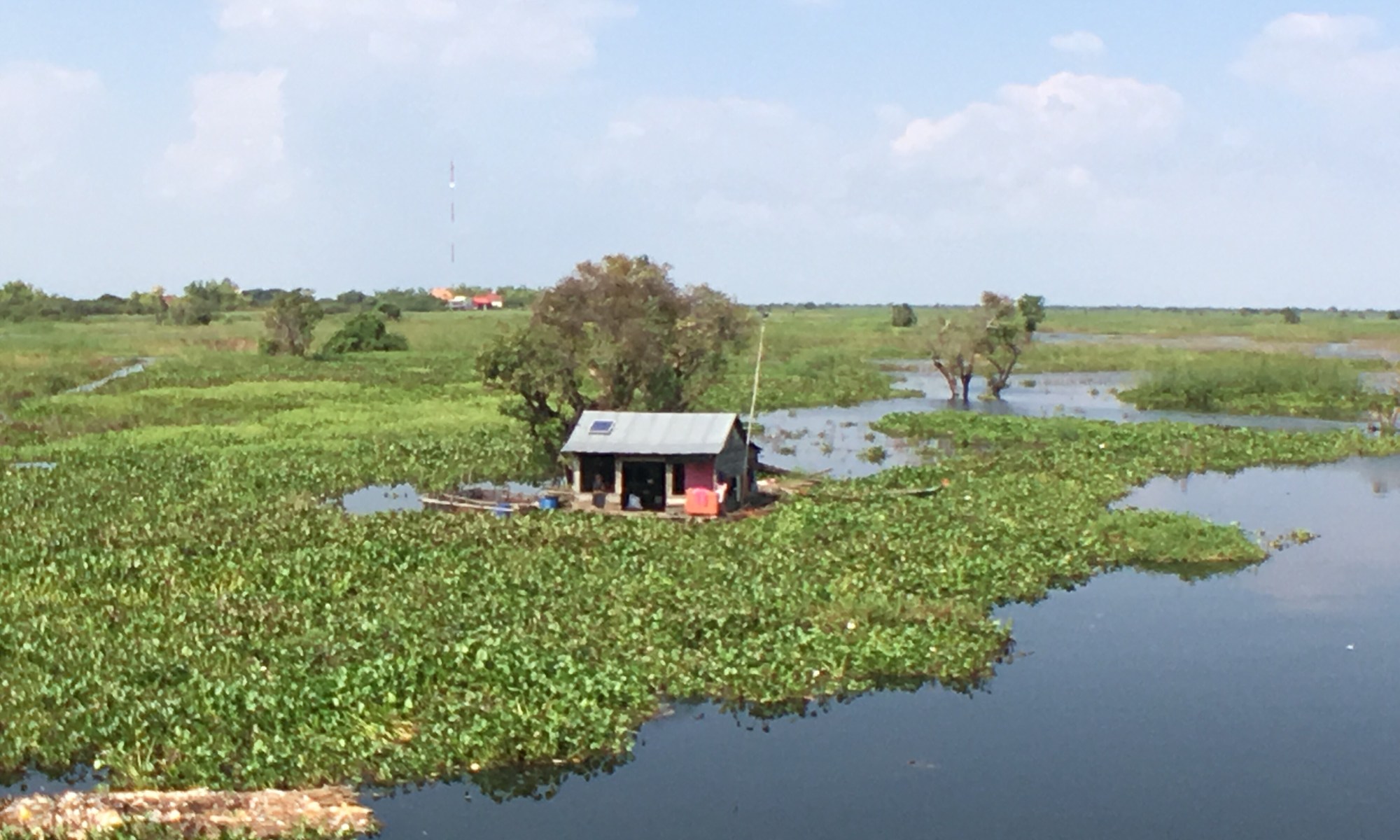
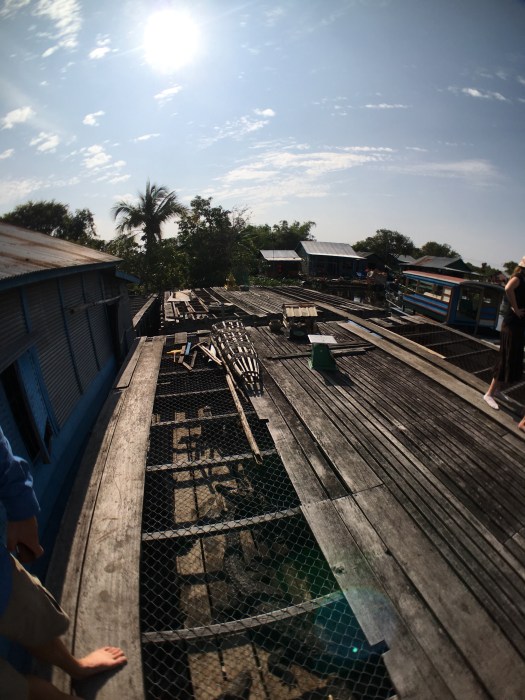
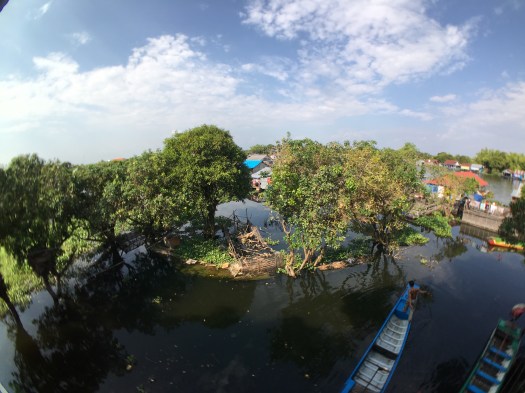
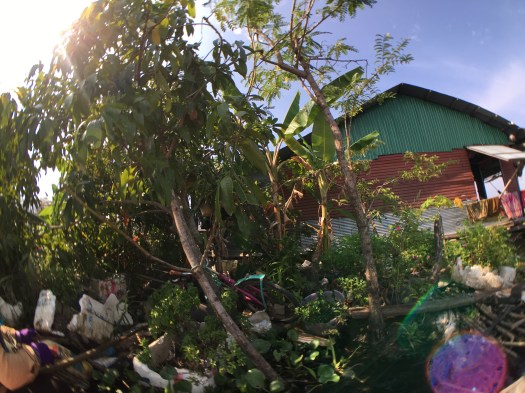
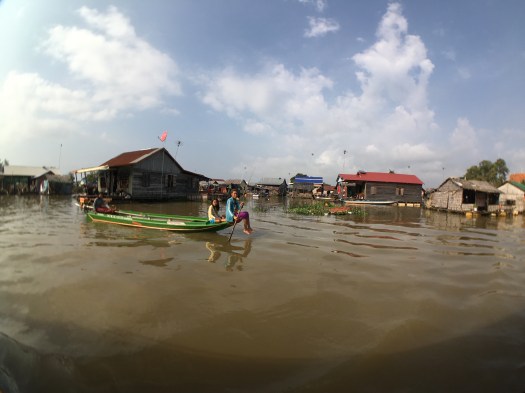
Tonle Sap Lake is SE Asia’s largest fresh water lake, fed by the Mekong and Tonle Sap rivers. As a result, this lake has been a coveted prize whose ownership has been desired for centuries. Large enough to feed a massive army and provide food for the more than 300,000 labourers who built Angkor Wat, Tonle Sap lake has been and continues to be an important food source. The lake is also home to thousands of people. Floating villages bob peacefully on the waters surface, while noisy long boats race through the watery forests carrying goods to and from the villages and small markets along the shoreline. The floating villages are home to the fishermen who make their living off Tonle Sap lake. Thousands of crocodiles, 300,000 tons of fish and 5 million water snakes per year are harvested from the lake. The people living in the floating villages must move their house up to ten times a year to adjust for changing water levels. Villages are very poor, but include all the necessities of life. Floating schools, stores, pig farms, churches, chicken coups and gardens. We had the privilege of visiting one of these villages by long boat. The village of Prek Toal. Home to 1,100 families and 10,000 people.

Not all villagers are poor. We learned that tour guides and hotel staff make about $150 USD per month. The wealthy crocodile farmers can make up to $300 USD per month. These wealthy families are few, the majority having little more than a small boat that serves as both home and livelihood.

We picked this particular tour as many of the floating villages in SE Asia have become overrun with tourists and vendors persistently hawking their goods to these same tourists. Prek Toal is a longer boat ride (I.e no bio breaks for several hours) through rougher water, discouraging many tourists from visiting. To our delight we had the opportunity to visit a floating village that exists merely for its residents and the markets that rely on the goods sold by the villagers. There were very few tourists and the town citizens went about daily life as though we weren’t present. No sad children or landmine victims tugging at your sleeve or following your every move.

Prek Toal is also unique as it is the home of Osmose Ecotours. A company that provides free education on sanitation and environmental conservation to the local villagers. They have also taught the local women the traditional art of “Saray”, or basket weaving. Weaving was becoming obsolete as more women turned to fishing as a source of income. To help conserve fish populations, provide good jobs and to help remove foreign and invasive plant species (water hyacinth), weaving was reintroduced. Women can make double the income from weaving as they can from fishing with the help of Osmose. We had the opportunity to learn this art by making a trivet. It was fun and a great way to engage with these women. Their skill is incredible, making beautiful handbags, bowls, placemats, jewelry and other goods from nothing more than dried weeds and handmade dies.

We then took a row boat to explore the local “floating” farming. Gardens, catfish farms and crocodile farms. It was amazing to see the ingenuity and simplicity of the gardens. Bamboo rafts with trees that provide “earth” to grow mango trees, herbs, banana trees and even custard apples!

The lake is also an important bird sanctuary. Large areas are conserved for the over 200 species of birds that live there, some of which are endangered. We visited a viewing platform that gave us incredible views of the lake. The lake is dotted with trees growing out of the lake bottom a few meters below the waters surface and is covered in large islands of drifting plants.

For the first time on this trip, a tour exceeded my expectations. I highly recommend taking a day away from temple hopping to visit this genuine and very special place.

Crocodile Farm10,000 people living on water!A floating garden.

Daily life when you live on a lake

Day 43: Angkor Temples

The Temples of Angkor City. A bucket list item since we first learned of their existence. The beauty and magnificence of the Temples is not only their age, or their size, or the architectural and engineering feat. For me it’s the diversity of the temples that is most awe inspiring. The sheer size of Angkor Wat, the beauty and intricacy of Bayon and the lush, jungle covered Ta Prohm. The reclining Buddha hidden in Baphoun and the formidable pyramid of Phimeanakas. What a day! With the assistance of our local guide Mr. Lake, we had a fantastic day. Topped off with a dinner of Cambodian dishes and several “special drink” that included gin, tequila, brandy, Cambodian liqueur and cherry cordial…where was I going with this?

Ahh to heck with it. All you want is the pictures.

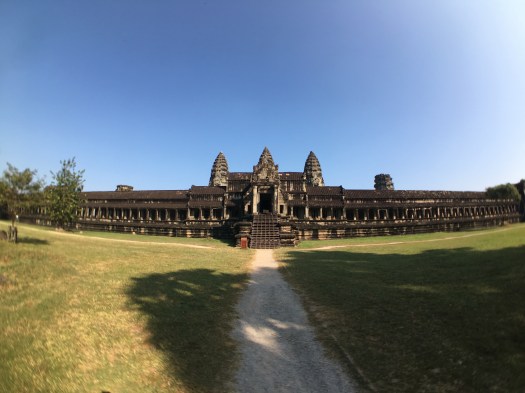
Angkor Wat

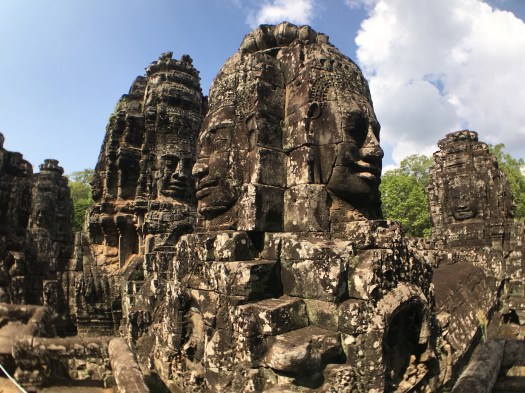
Bayon

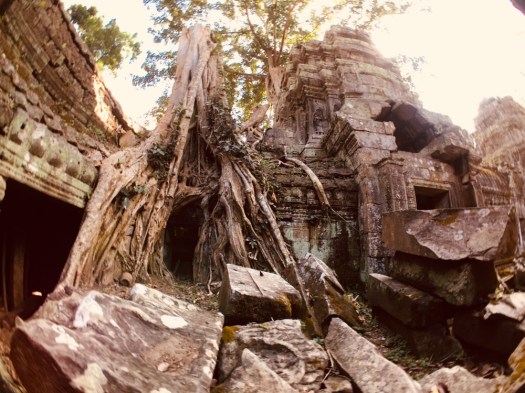
Ta Prohm

Phimeanakas

Day 42: Siem Reap Street Food

After giving our rain ponchos to some street vendors and selling our helmets to two Vietnamese men, we were off to Siem Reap. The Hanoi International Airport welcomed us with the beckoning neon light for Burger King. I had been craving a McDonald’s sundae, my “go to” motorcycle road trip treat, since leaving Canada. Shawn was craving a burger. BK would do.

We left Hanoi behind in the gray drizzle. Siem Reap welcomed us with warmth, a stunning sunset and incredible efficiency. 25 minutes from the time the plane landed to meeting our driver. This includes getting a visa, going through customs and getting our bags. Our driver was a wealth of knowledge. We learned that Angkor means “city” and Thom means “big”. The city of Angkor has 54 temples, one for each of the 54 provinces.

First activity, street food tour. We love to start exploring every new culture with a tour of its street food. It’s a great way to orient yourself to a new city, pick up a few basic phrases and figure out the local food scene. Most importantly, eating a scorpion has been on my bucket list since being stung by one a decade ago in Bonaire.

Sam from Backstreet Academy picked us up in a tuk-tuk. We highly recommend the tours offered by Backstreet Academy. Each tour offered is “owned” by a local. The proceeds of the tour go to the website provider (7%), the local guide, local driver and local artisans/vendors. Each tour is essentially a small business that is owned by locals.

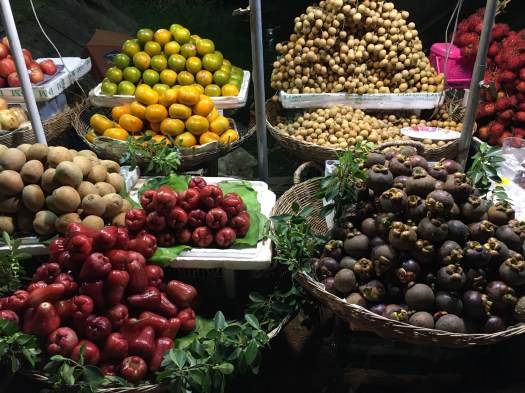
We headed to the Road 60 Market, a 2 km long street market that offers fruit, insects, BBQ meat and fish, clothes and amusement park rides. Here Sam introduced us to some amazing new fruit. Custard Apple, a green and knobby, thick skin hides a delicate, soft and sweet fruit inside. Nothing at all like an Apple, this was incredible. Next was the Milk Apple / Purple Star Apple. A purple fruit that, when quartered, resembles a beautiful flower. Not as sweet as the Custard Apple, the MilkApple has a delicate sweetness and is slightly more apple like in texture. Jackfruit and roasted jackfruit seeds, rambutan and Logan. Yum!

Incredible fruit.Custard Apple and Milk Apple

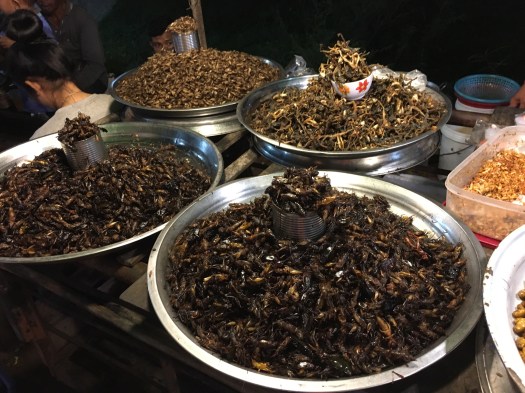
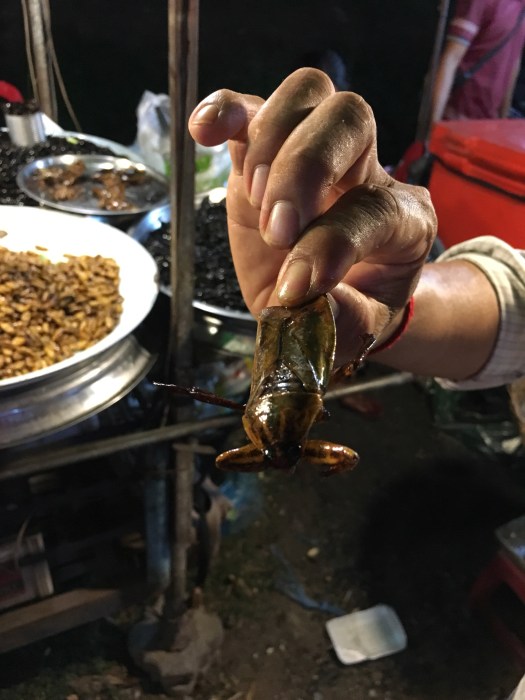
Next was the insects. Rice grasshoppers, crickets, silk worms, water cockroaches, and water beetles. Crunchy and light, except the meaty and mushy silk worm. For the most part tasteless, save the flavours of the various marinades used.

CricketsCockroach anyone?

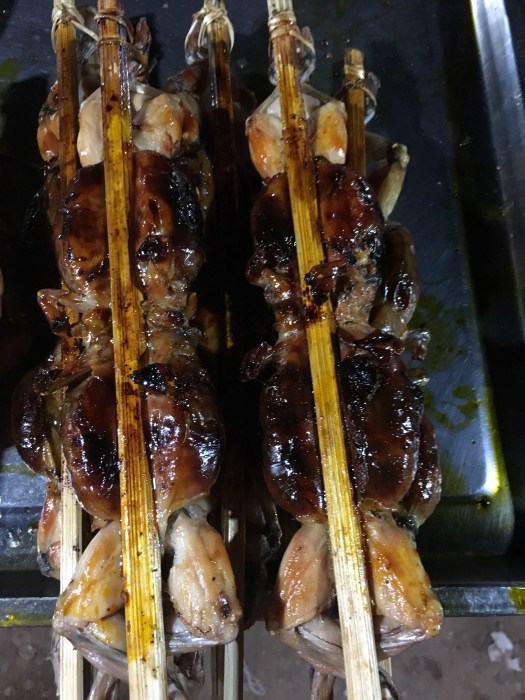
Next up, BBQ. Lemongrass stuffed frog and small, sardine like fish. The frog was wonderful, flavourful and delicate. At $2.50 each, we will be going back for more.

Stuffed Frog. Yum!

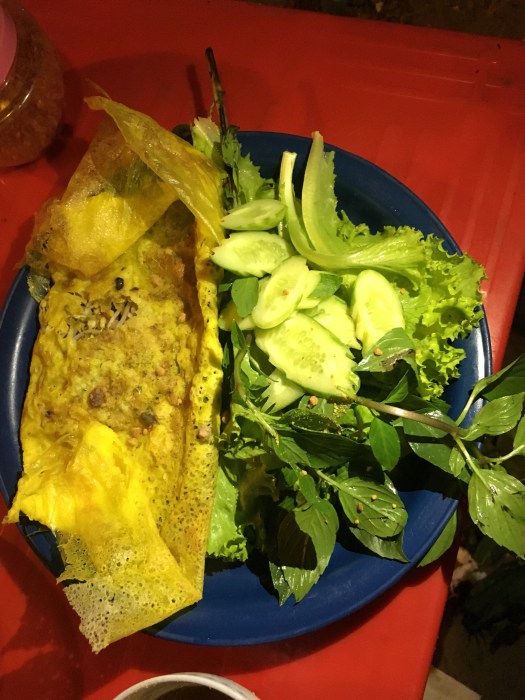
A traditional Cambodian stuffed pancake was next. A paper thin rice pancake filled with bean sprouts, pork and carrots. Served with lettuce, cucumber and mint, and a sweet dipping sauce. Another wonderful treat.

Cambodian stuffed rice pancake.

For dessert, sticky rice with coconut and sugar and wrapped in a delicate crepe.

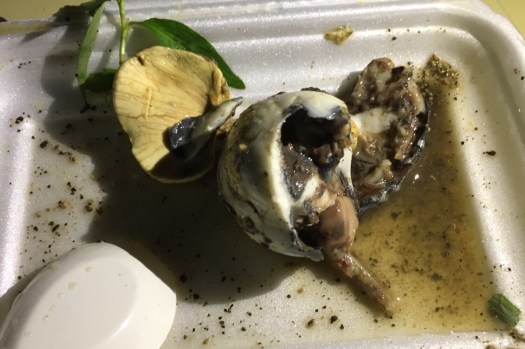
And then, the one food I was mesmerized by since learning of its existence. Fetal egg. An egg that has been fertilized and incubated, and then eaten within 18-21 days once specific body features have been formed. So basically a hard boiled egg that when cracked open reveals a tiny head and beak, body and other “characteristics”. I wasn’t sure I would be able to do this. But with a Cambodian beer in hand, I was ready to give it a go.

It was surprisingly good, if you could get past the texture. The taste is more or less like a hard boiled egg, but every bite a unique texture depending on the body part being eaten. I even found a tiny bone – the beak. I can’t say I will be trading in my standard eggs for fetal egg anytime soon, but I do see the appeal of eating this incredibly unique dish.

Fetal egg.

All in all another great street food tour. Highlights were the exotic fruits and stuffed frog!